making big news in Japan
The renowned Japanese scientist, Professor Satoshi Omura has recently been awarded joint Nobel Prize- 2015 in medi
Asubende-the tiny Ghanaian community
making big news in Japan
The renowned Japanese scientist, Professor Satoshi Omura has recently been awarded joint Nobel Prize- 2015 in medicine for the discoveries relating to a novel therapy against infections caused by roundworm parasites.
Reverberations of this prize award was felt in no bigger a place than Asubende, a tiny Ghanaian village, where the drug ivermectin is being hailed as panacea to river blindness, the disease that has become the scourge, incapacitating victims of black fly biting along the Volta river basin.
During the latter part of 2015 Asubende was besieged by a multitude of press corps relating to broadcasting systems in the nation of Japan.
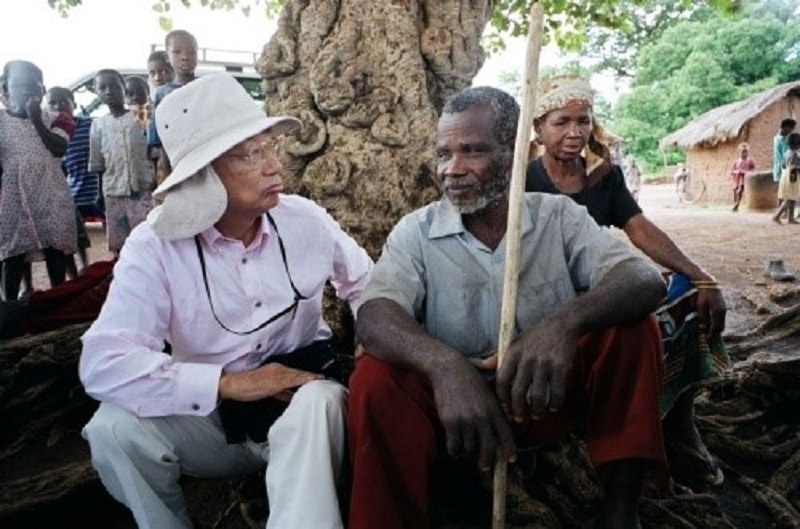
Professor Omura the Japanese Noble prize laureate once visited Asubende, to evaluate treatment from the drug.
Probably this visit was the catalyst to the sorties of press corps to this dying community in Ghana.
River blindness is one of the diseases manifested by the incidence of black fly biting, a phenomenon which is characterized by the fly invasion of the Volta basin of Ghana.
The challenge of black fly invasion that has affected the village has been part of the widespread scourge of the Volta basin of West Africa, an area that includes about 75% of Ghana’s landscape.
Little had been known of the relationship between the incidences of the fly biting and the blindness in the communities like Asubende until the late 1950s, when this discovery led to a mass intervention exercise, to douse the rivers of the basin with insecticides and control the black fly population in the communities.
Professor Omura, a microbiologist with long pursuit for the behavior of microbe organisms started his career, as a night school teacher in a Tokyo public school attended by factory workers.
His ardent work in science and medicine has made him a Nobel Prize laureate, which he jointly shares with two other colleagues from Ireland and China.
Earlier in 2004, Professor Omura visited Asubende in Ghana, to evaluate treatment of parasitic worm diseases that use his drug discovery, ivermectin, spearheaded by the World Health Organisation (WHO) that has gotten the incidence of river blindness and elephantiasis responding positively.
Professor Omura’s infectious smile and keen interest in the communities’ wellbeing that he portrayed during his visit won the hearts and minds of the people of Asubende, who now maintain reflective experience of this presence of the professor in the village.
Asubende, once a bustling community with most of the trappings of social amenities, those that settlers gravitated to, to enjoy the comfort in life is no longer the community that it was.
Asubende is now a dying community that is inhabited by six blind persons and their nuclei family of supporters that are adamant of the onslaught of the black fly attacks.
The vast majority of both other able bodied and blind settlers have abandoned the community.
Asubende is now a scar of its former self.
A community of about 800 inhabitants around the time of the Onchocerciasis Control Programmes’s (OCP) campaign is now reduced to less than 50 persons.
The prosperous market and vibrant entertainment spots that were then the envy of the other nearby communities have lost any trace of their earlier existence in the village.
The primary school built in the village is now just an evidence of its earlier prominence in the neighborhood, is now educating children mainly from other nearby villages.
In the early 2000s this strategy to exterminate the flack fly population, by dousing the rivers with insecticides proved to be quiet successful, but was changed to medication.
Ivermectin became the controlling drug, to curb the incidence of this blindness. Success from treatment of blindness by the use of the drug ivermectin is quite evident in the communities.
This strategy saw the increasing trend of the incidence of blindness halted, to the extent that there is no new reporting of blindness in the community since the introduction of the drug ivermectin.
More so, the itching experience of the skin of the victims of fly bite has subsided.
The people of Asubende appeared to have been freed from the worries of new incidences of blindness and the itching experience from these interventions, only to realize the glowing decline of the village’s population.
The black fly bite brings two discomforting experiences.
In addition to effecting blindness in the victims after about 20-30 years of continuing biting, the fly invasion also is a source of nuisance to the victims.
Blindness and elephantiasis have been the manifestations of illnesses from the fly biting.
Parasitic nodules that are deposited into the bodies of the victims during the biting metamorphose into either blindness agents or elephantiasis agents.
Luckily, both these diseases, including the itchiness on the skin of victims respond positively to ivermectin treatment.
The incidence of fly biting is a means of transmitting the parasite ochocerca volvulus into the victim. There are two strains of this parasite: the ones that are found in the savannah regions and those that are found in the forest zones.
Victims of the savannah parasites are prune to blindness, elephantiasis as well as skin itching. The ones that are found in the forest regions only bring about skin itching and colorations.
The challenge now to this incidence of fly biting therefore appears to be preventing the fly biting from happening in the first place.
Most humans and livestock are unable to cope with the nuisance of the fly biting and attacks; hence those with lighter heels have taken to them in moving out of the community.
The Volta basin of West Africa has no monopoly of this incidence of black fly attack.
All over the world, wherever there is a fast-flowing river has the potential to breed these flies, which in some later stages of their lifecycle are unleashed unto the neighboring communities.
In some parts of Canada black flies continue to cause human suffering and are a scourge to livestock.
In Saskatchewan (Canada), huge numbers of cattle are known to have been killed by black fly species attack during the outbreak years of 1944-47.
Black flies are of a nuisance to humans. For example, forest workers in northern British Columbia and Québec (both in Canada) demand black fly control as part of their work contract.
Examples of the scourge of this nuisance from the fly biting are common place all around the world.
The socio-economic impact of fly biting and its concomitant effects has been disastrous to the community of Asubende and indeed most of the communities in the basin.
Poverty and disease have become the hallmark of such communities. Manpower numbers have dwindled from Asubende, so has the throughput from the community.
The blindness has incapacitated its victims and their supporters.
The uncompromising attacks from the flies have drastically reduced farming and fishing activities that have hitherto been the mainstay of livelihood in the community.
School academic activities do sometimes get truncated, because of the biting onslaught of flies during the invasion seasons.
This incidence of black fly biting along the Volta basin has had its fair share of international attention.
Ever since the desolation of the Volta basin, which is arguably the most fertile lands of the West African region, was established during the 1950s, the communities have seen international support flowing inwards, to mitigate the onslaught of the black fly invasion on these communities.
In deed the World Bank sponsored the OCP campaign of aerial spraying of insecticides unto the rivers, in the bid to control the fly population. This strategy saw the black fly invasion incidence reduced considerably.
But this strategy was replaced by the use of the ivermectin drug, spearheaded by the WHO, to control the blindness in the communities.
All along, an impression seems to have been created that the dying community of Asubende and the likes has been the making of the incidence of river blindness.
However, the dark cloud precipitating the exodus of humans from Asubende is now known to have the fly biting nuisance as the rain inside.
The incidence of blindness appears to have been effectively controlled; thanks to Professor Omura and his colleagues’ invention of the ivermectin drug, of which the remnant community is highly gracious.
Most of the villagers believe that they owe their freedom from blindness and the body itching to this illustrious son of Japan and his other colleagues.
Unlike the humans of Canada, who have the ability to negotiate for safer working conditions in order to sustain their living, their livestock neighbours paid the price with their lives for living in such challenging conditions.
Had they the ability to choose their living conditions the livestock would prefer to abandon such an environment for safer grounds.
Likewise, the human victims of the Volta basin’s motivation to abandon their infected communities for safer grounds have been the freedom from the fly biting.
The worldwide acclaimed cliché as to Ghana being a nice place to live is a dirge to the ears of the people of Asubende.
As nuisance from the fly biting continues unabated, more and more of the people are contemplating taking to their heels and making it out of Asubende.
These are not those perturbed by the prospect of incidence of new blindness, but rather by the nuisance from the biting and skin coloration from the flies.
The case must therefore be established that the dying communities of Asubende and others could be the outcome of the nuisance from the fly biting rather than the blindness as it was widely held.
Words from the communities of the Volta basin may not be enough to express gratitude to Professor Omura and his other colleagues for the invention of this drug that appears to be the panacea to blindness and skin itching in the communities like Asubende.
As the fanfare of the Nobel Prize award rages on, it is the fervent wish of the people of Asubende, to join Professor Omura in the celebrations, but poverty and sickness stand between their wishes and the realities.
When the hurly-burly is done and the dust settles, as the of war between humans and the invading black flies is lost and won, the person to turn off the last burning-lamp at Asubende should be on the lookout for a Japanese emissary.
To Professor Omura and his other colleagues the people of Asubende, and for that matter Ghana, and the entire Volta basin salute you on this big achievement of yours.
Professor, Ayekooo!!
GBC/Carl Wiafe's Report